Divine Androgyny: The Alchemical Process
“‘Male and Female He created them’
From here we learn:
Any Image that does not embrace male and female
Is not a high and true image.”
In a culture dominated by male hierarchy and patriarchy, the divine image of the female is often shoved aside and considered an object of “simple” goddess worship which cannot compare to the deeply rooted tradition of understanding the divine as male. Indeed, some of us often forget how important it is to allow God to express itself through the feminine energy of the universe. And when both the masculine and feminine energies of God are joined together within a person, this person takes on the ultimate form of our humanity--that is the androgynous being that mirrors God. My hope for this post is that I may bring to light just a few of these very important spiritual teachings in mystical thought. First, however, one should understand that when I or the mystics talk about the masculine and feminine side of God we are referring to the metaphysical attributes of God: the masculine being aspects of knowledge, power, fire, action, and reason; whereas the feminine being aspects of wisdom, compassion, water, breath, and contemplation.
The quote above can be found in the Zohar, a late thirteenth century Jewish mystical work from which the Kabbalah arose. Simply put, the Zohar (the Book of Splendor, Radiance, and Enlightenment) is a massive mystical commentary on the Torah. This quote is specifically dealing with the creation story of Genesis 5.1-2. “This is the book of the generations of Adam. On the day that God created Adam, in the likeness of God He created him; male and female He created them. He blessed them and called their name Adam on the day they were created.”The author of the Zohar continues his comments by saying…
“The Blessed Holy One does not place His abode
In any place where male and female are not found together...
A human being is only called Adam
When Male and female are as one.”
In other words, the author is stating that one is not fully human, or does not represent one’s full humanity until that person has embraced both the masculine and feminine parts of creation.This mystical teaching is not only found in the Zohar.
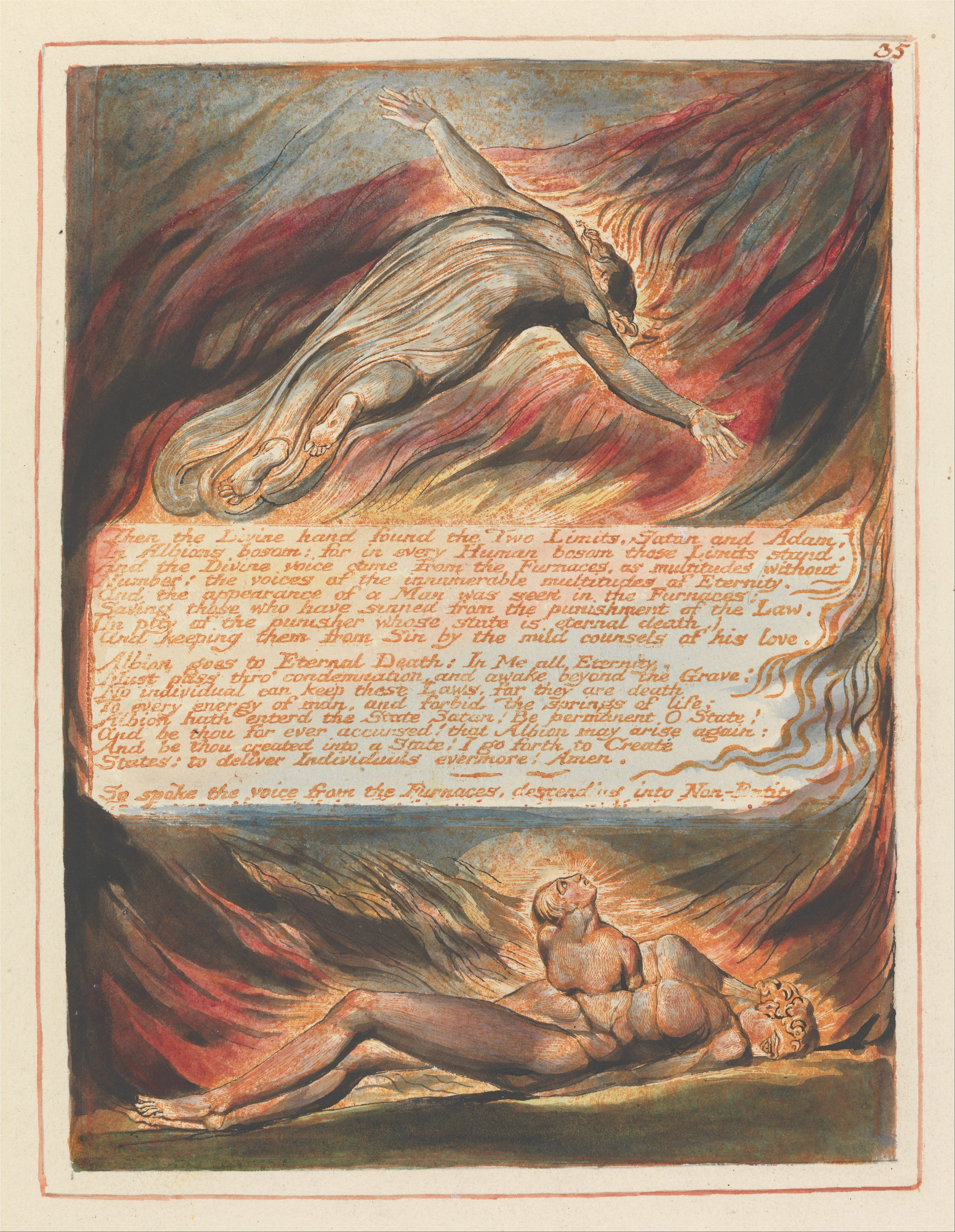
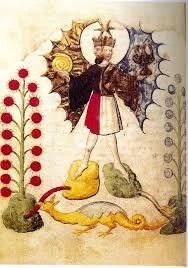
Indeed, spiritual and philosophical alchemy refer to the fall of A-dam (A-dam being the embodiment of both male and female) as the separation of humanity from this holy androgyny. Jacob Boehme and William Blake use this idea in their writings and illustrations by showing the way in which “[A-dam] was a man and a woman at the same time…” Yet this form is to be understood as more of an ethereal or spiritual manifestation which became material after the fall.
“The fall of Adam drew with it the the fall of [humanity] from an original, inner unity into the external world of opposites.” The unity of male in the form of red clay (Adamah, red earth) and the female as Sophia (or wisdom) separated due to Satan inciting the fiery wrath of God which hardened Adam into his material existence and forced Eve to become a spiritual emanation--i.e. it separated the two forms. Yet for Blake, Boehme, and other mystics, Christ’s purpose is to restore humanity to is true self by awakening the Sophia within our harden material clay bodies.
“The central task of earthly existence was the redemption of...the unification of the two parts. The path there leads, according to Blake, through sensual delights and physical fulfillment, and it is distorted by false moral teachings and dogmatic religiosity as the chief instruments of sexual repression.”
In other words, the male (sun or gold) and female (moon or silver) forms are, therefore, to be lit by the fires of the alchemical process (Christ’s Love) in order to melt the two together for the purpose of an ultimate and divine androgynous union. Moreover, Boehme continues to use this metaphysical form to describe what our spiritual life will be like in heaven.
"The student said: 'Will there be man and woman in the spiritual life or children or kindred?'... The master said: 'How have you become fleshly minded? There shall be neither man nor woman, but all shall be like God's angels, androgynous virgins, neither daughter, son, brother, nor sister, but all one sex in Christ, all of one piece like a tree with its branches, and yet separate creatures; but God all in all.'"
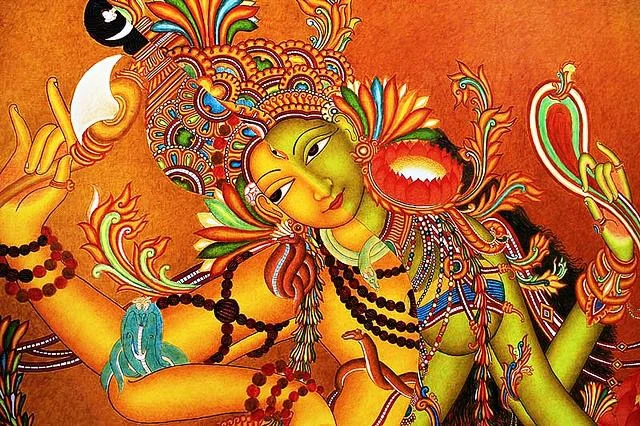
In addition to the Zohar and the alchemical teachings of Boehme, Hinduism also talks about the union between the male and female forms by using the image of Ardhanarishvara. Normally attributed to the God Shiva and Goddess Shakti, Ardhanarishvara is the unity between Purusha (consciousness) and Prakriti (materiality), thus “depicting the perfect ‘devine’ [as in devi or goddess] union of the polar energies of the universe.”
Again these are only a few of teachings within major religious traditions that discuss the divine androgynous union of both male and female within humanity. Though the traditions may differ in regards to how one is to achieve this--i.e. through spiritual practices, philosophies, and theologies--they all emphasize how important this mystical knowledge is for one to understand and experience.