Crucified, Died, Buried, and Descended into Hell

My dear reader, a question that I pose to myself everyday has to deal with the suffering of the world. It is not the usual question of theodicy: “How can (a) God exist if there is so much suffering?” Rather, it is one of action. The philosophical and theological musings above mean nothing if they are not acted out and embodied in the world. What I mean by this is that contemplation can only go so far until it becomes utterly useless. Of course action first begins within the soul of the individual in the sense that one must take the first step of action by withdrawing into oneself for the purpose of seeking change--i.e. contemplation. The very act of contemplating is an action itself however individualistic it is by nature. Yet, again, it is limited only to the one who is doing the contemplating. The word change is a verb. It requires the action of a subject for it to occur. Therefore, without action, contemplation--a noun--cannot exist. First, one must undergo an inner change in order to produce an outward change, and this outward change only happens through action. The famous quote from Mahatma Ghandi, “Be the change in the world you wish to see,” emphasizes this very principle.
One can see how the theology of action is represented in this part of the Apostle’s Creed because it is filled with verbs such as: conceived, born, suffered, crucified, died, buried, descended. These all represent the actions that either happened for Jesus to enter into this world, or happened to Jesus in order to fulfill the prophetic utterances in the Hebrew Bible. However, most of them also deal with suffering. It is through this suffering of Jesus--who, as mentioned above, is represented as God’s material incarnation, and who is a representation of all humanity and its ability to enter into union with God--that we are called to action as a response for the alleviation of world wide suffering.
My first experience of a religious response (action) to suffering came during a Religious Studies course on Afro-Caribbean Religions. The emphasis of study in this course was on the Rastafarian movement in Jamaica and the greater international community. Rastafarian identity is deeply embedded in the years of suffering during colonization and the slave trade. Their African ancestors endured four hundred plus years of brutal downpression (oppression). On these plantations slaves were forced to convert from their African religious identity to the white man's biblically supported, racist, and deplorable version of christianity. However, throughout the struggle, men and women held on to their african traditions. Keeping them alive by secretly practicing their cultural spirituality. Indeed these small rebellious responses to colonialism have a major impact on what it means to live as a Rasta in the twenty and twenty-first century. It is a religious movement that practices contemplation, meditation, and devotion to Jah (God) that also deliberately seeks peace, justice, and reconciliation throughout the world as its livitity (lifestyle). Social justice and activism lay at the roots of the Rasta religious movement, and combined with spirituality the movement is an international phenomenon which speaks to and for the experience of those suffering in the world.

The second time I had experienced religious communities or organizations responding to people’s struggle and oppression was during an undergraduate study abroad in Gulu Uganda. Part of the program required an internship based experience at an organization that worked towards building peace and reconciliation after years of war between the Lord’s Resistance Army (LRA) and President Museveni’s National Resistance Army--which is now the Government of Uganda (GoU). I worked as an intern with the Acholi Religious Leaders Peace Initiative (ARLPI), an interfaith non-governmental organization (NGO) “that works for peace and development by transforming violent conflict through dialogue, negotiation, mediation and reconciliation in order to promote sustainable peacebuilding and development in Northern Uganda.” The war in Uganda between the LRA and President Museveni’s NRA displaced millions of people in north. During the late ‘90s, Museveni forced the those people into Internally Displaced Persons Camps (IDP camps). Moreover, if these people stayed in their homes rather than entering into an IDP camp, they were considered by the NRA to be rebel collaborators and immediately killed and their villages destroyed. If they went to the IDP camps, however, they were then considered by the LRA to be government sympathizers and were also killed and their villages were set on fire. This is where ARLPI stepped in as a grassroots religious organization that represented the people of northern Uganda--not the NRA nor the LRA--to promote peace and reconciliation, mitigation, and land conflict resolution during and after the war.
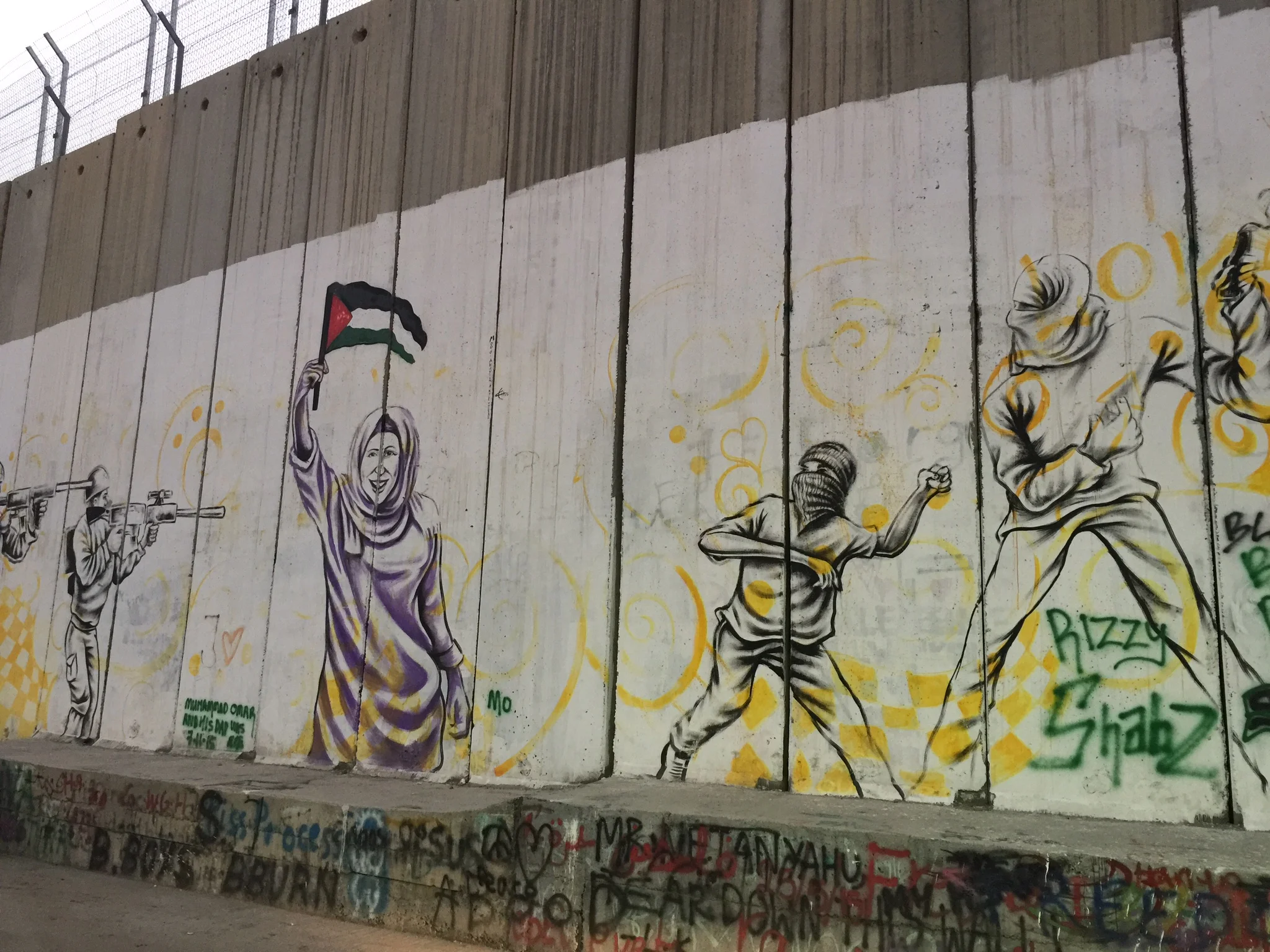
The third experience I had of religious communities responding to suffering was my recent study abroad/immersion in Israel/Palestine. I learned about the theology of Martyria, or the theology of Witness, from the Lutheran Bishop Munib Younan. I learned how local Palestinian Christian churches use their identity to work with those persecuted by the Israeli occupation. And I learned how I too can be a witness for our Arab Palestinian Christian, Muslim, and Jewish brothers and sisters who are suffering. Working at the grassroots level, justice for Palestinians is enacted through the need for international recognition of equal rights and human rights. The deontological duties of working for justice within Palestine requires the acknowledgement of the human rights violations that Israel is committing. Due to the emphasis on governmental affairs and the political context of current society, religious organizations or people of faith fighting for justice rely on international human rights laws and the world wide recognition of the Israeli government’s violation of them. Every religious institution that the immersion group visited discussed the occupation not only in religious language, but primarily through the means of discussing the political and historical context of the land. Regardless of the religious justification of equal rights, religious organizations used grassroots activism for the liberation of Palestinian people and fighting the matrix of control.
Moreover, though the Israeli government creates a seemingly hopeless and inhospitable living environment, Palestinian organizations are maximizing their efforts to keep hope alive. Programs which educate and train Palestinian youth and women empower the people by giving them a voice which they can utilize for productive mobilization against the Israeli government and for a just peace. For example, the Y.W.C.A.’s youth program teaches the younger generation how to enter into dialogue with the government by training them to be agents of change. This work is allowing the Palestinian people to utilize their voice to tell the truth about the situation, and telling the truth in regards to the occupation means telling the narrative of the Palestinian plight. The work of these organizations, therefore, is to mainstream this narrative and create a safe-place in which the Palestinian people can speak out against the injustices that they are facing and tell their stories; while also allowing others to have the opportunity to be witnesses to their struggles.
All three of these experiences that are religious responses to suffering in this world have one thing in common: recognizing the power of one’s voice. Allowing one to share his/her story regarding the suffering endured on this journey through life creates a narrative for the individual through his/her own language. Indeed, I believe that the most powerful tools for a minister are knowing how to listen and to practice emotional intelligence. In my Pastoral Counseling and Care course I learned skills that would help a ‘seeker’ construct their own personal story and allow them to listen to feelings inside them regarding any experience. And yet we ministers who are in this position are not doing anything; for when we let God sit down with the person before we do, the Spirit simply uses us as a witness to the other person’s narrative. Practicing emotional intelligence keeps us aware of the different thoughts and feelings that are being vocalized, and the Spirit may ask us to emphasize certain emotions that would lead to the healing of the individual. There is a lot of suffering in this world, and as we learn from the Buddhist tradition, this suffering is the result of attachment. Our roles as ministers are to be a witness to those suffering by allow them to use their own voice to create their story, and to simply walk with them through their journey no matter how far they descend into hell.