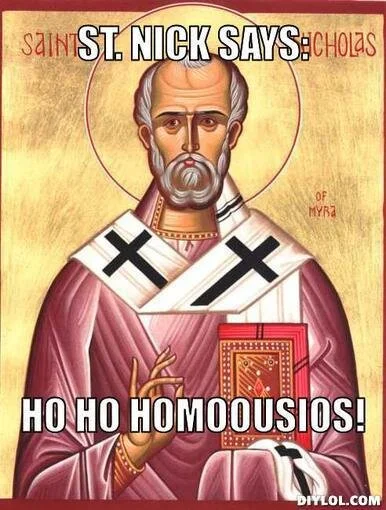
Saint Nicholas

If you don’t immediately laugh at the meme above, don’t worry; it took me three years of seminary to fully understand it. It revolves around the Arian controversy during the Council of Nicaea (c.325), where Santa slapped a Bishop.
Saint Nicholas the Wonderworker (dare I add gift giver?) and Bishop of Myra is the real life version of Santa Claus. As we approach Yuletide and all its splendor, I thought I would write about the actual St. Nick by gazing at some icons, sharing stories, and connecting them to the Christmas message. So, back to slapping a Bishop.
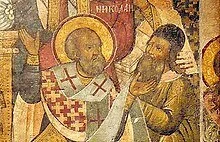
St. Nick winding up to slap the heresy out of Arius.
In order to understand what angered our jolly St. Nicholas so much, one has to dive into the theology of Christ’s personhood. The Arian controversy arose during the Council of Nicaea because christian bishops were debating whether Jesus was the ‘same as’ (homoousios) or ‘similar to’ (homoiousios) God. Bishop Arius was a proponent of the latter. He believed that the personhood of Jesus kept Christ from being the very same essence and energy of God; whereas our beloved saint--and the rest of the council for that matter--said Jesus and God are the same. Remember, Christianity at this time was going through major identity transformations as christian communities all over the Roman Empire began defining teachings and philosophies for the Church. The result was a heated conversation between both episcopate sides. Supposedly the arguments were so bad that they caused St. Nick to get angry with Bishop Arius and he got up from his seat, walked right over to Arius, and slapped him. So legend has it anyway, but this holy slap has been portrayed in Christian iconography ever since.
My first encounter with iconography of St. Nicholas was during seminary. I was taking a class with a Greek Orthodox Metropolitan as the professor, and near the end of the fall semester he brought out one of his favorite icons of St. Nick--St. Nicholas saving the sailors. There are two stories about his maritime intercession. The first is that our saint went on pilgrimage to the Holy Land. During his travels, he had to sail with other pilgrims. One night he dreamed of a terrible storm that would arise and destroy the ship. The following morning St. Nick warned the sailors of the impending doom, but in faith they replied that God would protect them. When the storm hit, St. Nicholas went into deep prayer, and though one sailor was tossed overboard and drowned, the storm quieted down and our saint revived the man (resurrected or resuscitated?). The other story also revolves around a ship heading into a storm; however, St. Nicholas was not aboard. The sailors prayed to him because, by then, he was well known by sailors to offer his help. He then physically appeared on board, helped them through the storm, and disappeared thereafter. Later, they landed in Myra and ran into St. Nick on the streets, asking how in the world was he able to help them.
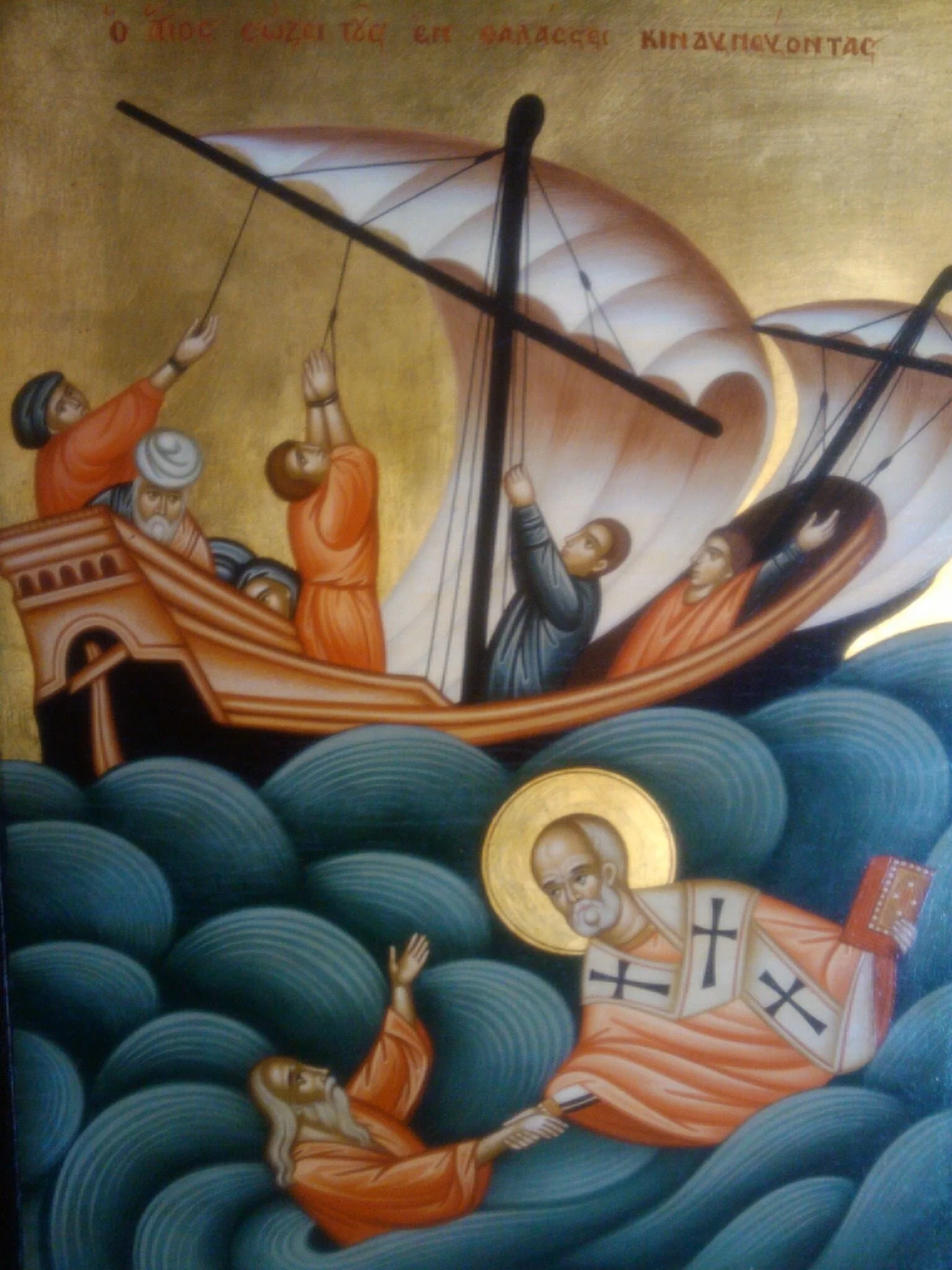
St. Nicholas and the Sailors
“They asked Nicholas how he had heard them and been able to come to their rescue. Nicholas replied that a life devoted to God allows a person to be so clear-sighted as to be able to actually see others in danger and hear their calls for help. The bishop urged the sailors to devote their lives to God and, thereby, to help people in need.”--St. Nicholas Center
These stories should sound familiar to you as they are similar to Jesus’s own calming of the storm for his disciples. (Notice how I said ‘similar to’ instead of ‘the same as’...)
Ever since seeing that icon at seminary and hearing the Metropolitan tell us the stories of St. Nicholas, I have loved the real Saint Nicholas more than our modern Santa Claus. But how did the stories of a fourth century Bishop become commercialized for today’s consumerist culture? We must turn to another story of the truly good saint Nick.
It was a time of trial and tribulation for one family in Myra. A man with three daughters didn’t have money for their dowries, and the bishop intervened before the man had to sell his daughters into slavery. The story goes that St. Nick eventually heard of the man’s distress and potentially difficult outcome. Trying to be anonymous, St. Nicholas snuck around the streets of Myra at night, seeking this poor man’s home. Once found, Nick threw a couple coin pouches through the window. Miraculously, the family had hung their dirty pre-medieval stockings on the fireplace to dry; and the coin pouches landed inside them (that’s actually the miraculous part…). Naturally, the man was elated in the morning and quickly married off his first daughter. This happened again for the second and third daughters: St. Nick, a Christian Bishop; who slapped another bishop because of a theological dispute; who miraculously apparated on a ship in the middle of the Mediterrannean Sea; was sneaking around his town--most probably in full bishop regalia, hat and all--throwing money into people’s windows.
I love it.
These are just some of the stories, legends, and myths that surround our Christmas saint. His feast day is tomorrow (Dec. 19th); it was December 6th for us westerners. It is this close timing to Christmas Day, as well as the story just above, that caused the transformation of Saint Nicholas into Santa Claus. However, when or if you further explore the patron saint of sailors, you’ll find a selfless individual whose life always directed one toward Jesus Christ. Each story I’ve read, revealed a christian leader that cared for his flock. He imitated Jesus by teaching, healing, and saving individuals. And just as Christ pointed to God as being the ultimate Love and focus of our lives, so too did St. Nicholas emphasize the God in Christ, the Christ as God, and the Human and Divine as one in Jesus.
So, as we celebrate the life of our beloved ancestor Saint Nicholas by offering gratitude to God for working through St. Nick’s wonder workings, compassionate givings, and prayer intercessions, let us not forget the deep teachings of his life’s work: to show us the true nature of Jesus Christ’s compassionate presence in our own lives. And, as we await our Lord and Savior’s miraculous birth into this world, let us rejoice with the communion of saints--especially our holly jolly, rosy-cheeked, overly-merry, red-and-white-fur-wearing, bishop-slapping, Saint Nicholas.