Three Types of Jesus: Part One
Once when Jesus was praying alone, with only the disciples near him, he asked them, “Who do the crowds say that I am?” They answered, “John the Baptist; but others, Elijah; and still others, that one of the ancient prophets has arisen.” He said to them, “But who do you say that I am?”
(Luke 9.18-20)
The passage above is one of my favorite verses in the New Testament. It is told slightly different in all of the gospels, and surprisingly John, the gospel with the most divinized version of Jesus, doesn’t mention this conversation at all. And I love how Jesus doesn’t answer the question in the other three gospels, rather he leaves it open by discussing the suffering Son of Man; though Jesus does indeed get excited about Peter’s answer in Matthew, thus calling him the Rock of the Church and giving him some mystical set of keys. But even then, he is not exclaiming that Peter is correct in his answer, instead he says that God revealed that answer to Peter. Jesus neither affirms nor denies the title and answers given.
Understanding that there can be many different ways of viewing Jesus leads me to write. Because when I imagine Jesus asking me this question, I give him three answers: the Jesus everyone knows, the Jesus no-one knows, and the Jesus I know.

The Jesus everyone knows is the one of fundegelicals, atheists, and those spiritually traumatized. He is either the butt of a joke, or the one condemning society. In fundagelical circles, this Jesus is loved for what he can do for you—only if you accept him as your Lord and Savior. He can make you rich, happy, correct in every argument, and justified in persecuting others. He is all powerful, and often here in America, he is viewed as the biggest patriot by using his power to influence the government.

For atheists and those spiritually traumatized this Jesus is angry, abusive, forgetful, and unjust in his judgements. Though he may have started off loving, they experience him as overwhelmingly negative. This view of Jesus is directly influenced by the fundagelical one above and is in the same vein of thought and experience. Jesus thus becomes the exact opposite of the fundagelical’s Jesus.
Divine? No, not divine. Not even real.
Loving? Only to and for his believers.
True? Superstition cannot be true.
All powerful? Just look at the world and its suffering.
I often talk about this Jesus as well, more so in the latter group than former. I too have felt traumatized by this Jesus. I too have had to step back and say that he doesn’t exist. I too use his name jokingly. I have slandered this Jesus more times than I’d like to admit. When he condemns me, I condemn him right back. If he tries to hug me, I push him away. Every time this Jesus tries to convince me of his existence, I simply laugh and move on.

This Jesus is a living ghost in today’s society. What I mean is that this Jesus began dying long ago, died recently (give or take around the election of Trump), and survives only in the memory of his most devout followers. The irony is that these very followers are the ones that killed him. Not the atheists or spiritually traumatized, but those that deeply love him. The fundagelicals cling to the ghost of this dead Jesus, survived only in their memories and confined to their churches.
The second Jesus is the one no-one really knows about. Not that this Jesus is esoteric or some divine secret only select groups of spiritual and religious elites know about. Rather, this Jesus is the historical figure, compassionate lover, and Cosmic Christ. His name is Yeshua.
Yeshua was born, lived, and died in Palestinian territories of the ancient near east. He was a Jew living in a Roman occupied land with the central hub of his religion under constant threat of being destroyed. Greco-Roman elites ruled the cities while revolutionary zealots ruled the streets. Temple authorities were cozy with the former rather than the latter. But this was a necessary political move by the temple elite so as to keep order within Jerusalem. The Judaic peoples had experienced far too much bloodshed in their lived history, and the priests/rabbis didn’t want to see their people die at the sword of one more occupier.

Out of this context rises a figure that challenges the status quo by offering compassion instead of law, love instead of order, healing instead of sacrifice. Yeshua stands at odds with, but still within, his historical context simply because he treated people like humans. He saw their needs and listened, healed, and loved them. This historical Jesus was a revolutionary that made zealots look like romans. Because of this compassion he became known as Christ.
The messiah, the Christ, is a title given to him by his followers. The first account being that of Peter’s declaration. But this first proclamation of Yeshua as Messiah was still understood as being politically motivated; meaning that the historical messiah was a king that would overthrow the worldly authorities in order to re-establish the Davidic lineage. But Yeshua didn’t concern himself with beginning a coup that would lead, again, to the deaths of thousands on both sides. Instead, he taught about the Cosmic Christ.
Yeshua believed and taught that the Son of Man either had come or was coming. Through him came the teachings and understanding of this Man/Divine Human (I’m going to switch from Son of Man to Divine Human, for this is more in line with the title). He taught that the Divine Human, the divine spark of humanity, was the focus of messiahship; a radically different interpretation of messianism than that of his—and our—contemporaries. The Cosmic Christ of Yeshua had come to change humanity’s outlook on God. That is, to alter humanity’s perception about God by proclaiming that God dwells within humanity; within us. Yeshua displays this through his compassion within his own historical context, a time ripe for his seed to bear fruit.
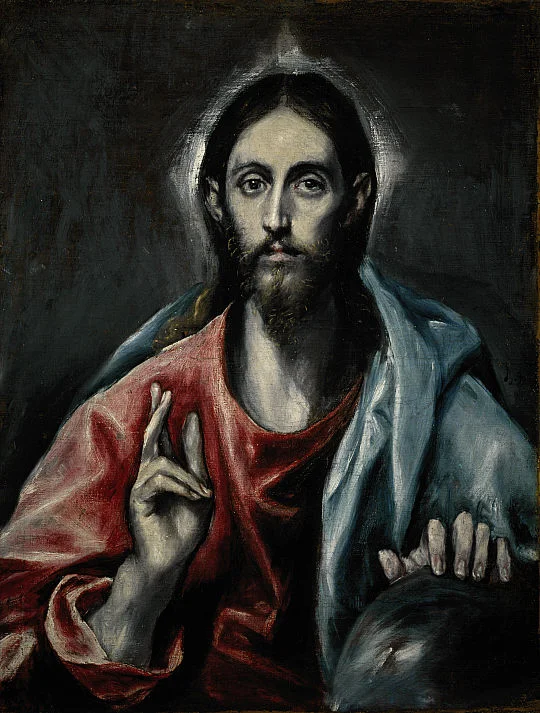
Christ's Blessing: El Greco, c.1600
However, not many people can see or have seen this Jesus. He is confined to history and theology books few outside of seminary read. Instead, his story is glossed over in society because of the fundagelical/atheist Jesus and his devout followers. The fundagelical/atheist Jesus has dominated Christianity’s narrative for so long that society either doesn’t know about Yeshua or won’t give him the time of day. Though I will later discuss the third Jesus, the Jesus I know, I believe that if society can embrace the historical Yeshua—even without proclaiming him as divine or as a god—then Humanity will understand the power of his teaching. That is, we all are Divine Humans and Children of God; that God dwells within us all; that we all are part of the Cosmic Christ.