Apocalypse in the Book of Daniel
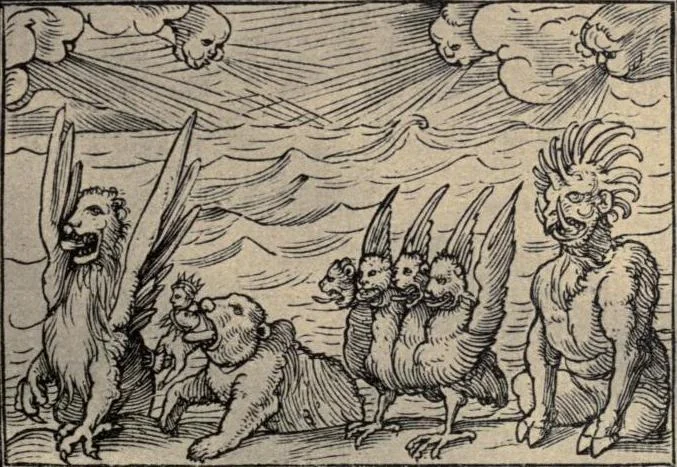
Hans Holbein the Younger
Historical Context
The historical context of Daniel 7-12 is concerned with two major periods of Judaic history: the Babylonian captivity and Hellenization. Regarding the former, the writer(s) of Daniel located the text during the time of the Babylonian exile. The entire book is set in the 6th century BCE when the prophet Daniel, an exiled aristocratic Israelite, is selected to serve in the courts as a dream interpreter for Babylonian kings Nebuchadnezzar and Belshazzar and the Persian kings Darius and Cyrus. The first half of the book primarily discusses the events around these kings; whereas the latter half uses apocalyptic imagery to describe the rule of the Greeks.
Hellenization occurred when Alexander the Great conquered much of the ancient Near East around 334 BCE. The influx of Greek culture mostly had a positive impact on Israel, but it was not an immediate change. Over the years of graeco imperialization, Greek culture was sought out by native Near Eastern peoples “to gain status and advantage by learning Greek and adopting Greek customs.” However, the rulers and wars that came with Hellenization had a major impact on the Jewish people; which Daniel 7-12 is responding to.
For example, Daniel’s visions of terrible beasts and animals represent the historical context of Israel during this time. Beginning with the Babylonians, but focusing on the Seleucid rulers Antiochus III & IV, these later chapters of Daniel reveal the terrible atrocities that occur in the 2nd century. It is a time of violent revolts under the Maccabean Jewish community; as well as the beginning of apocalyptic literature by the Daniel community in order to wisely resist their conquerors.
Genres
Chapter 12 in the Book of Daniel contains three genres of literature: apocalyptic, wisdom, and resistance. Regarding the first, ch.12 is an apocalyptic text because it is a visionary revelation given to the Daniel character about the end times and life after death. In his vision, Daniel hears one of the two men dressed in linen ask the other, “How long shall it be until the end of these wonders?” The other responds by raising his arms upwards “toward heaven” and revealing that the end will come in “a time, two times, and half a time”. This timeframe sets the date for when the dead will be resurrected; or rather, when some will enter eternal life.
Jewish apocalyptic literature uses the idea of life after death as a way of revealing wisdom to its readers. In the context mentioned above, atrocities and violence were an everyday reality for the Jewish communities. They were confronted with questions about justice; why do good things happen to bad people and vice versa? The Jewish concept of death before the 2nd century was that “[life] in its proper sense ends at death” even though “there is some shadowy vestige” that goes to a place called Sheol. Daniel, in ch 12, reveals another conception of the afterlife by discussing the resurrection of the dead in vv. 2-3.
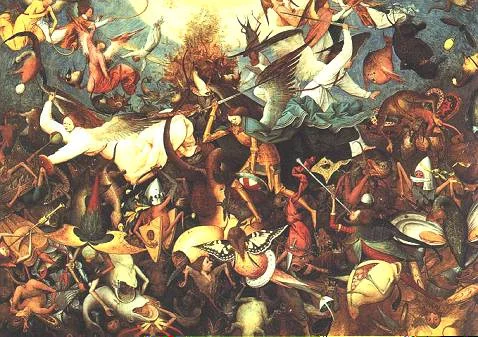
Pieter Bruegel the Elder, The Fall of the Rebel Angels, 1562
This is specifically a wisdom text because it shows the reader that he/she can enter into everlasting life by living righteously. Daniel specifically reveals that is is the wise that “shall shine like the brightness of the sky,” which he follows by equating the wise with righteousness. In other words, this apocalyptic styled chapter in Daniel is also wisdom literature because it reveals how--through righteousness--one can enter into everlasting life; whereas on the other hand, this passage in Daniel is also resistance literature because the wicked will eternally perish.
Again, understanding the horrible context mentioned above will help one understand how this apocalyptic text is also resistance literature. Specifically, the Jewish people are suffering wicked atrocities at the hands of Antiochus. Daniel’s vision of the two men dressed in linen reveal that though many will “be purified...the wicked shall continue to act wickedly,” and that “[none] of the wicked shall understand.” By revealing that the wicked will not understand like the wise, they will not enter into eternal life.
In other words, the Daniel community--unlike the Maccabean community--is telling the Jewish people to remain vigilant by waiting out the evil rulers and staying faithful to their ancestral heritage. This provides the framework of postmortem justice; meaning, that though the Jewish people are enduring a terrible life now, justice will come through Michael by the righteous attaining eternal life and the wicked vanishing completely from existence. Resistance, therefore, means waiting patiently and remaining righteous until the end times.
Personal Reflection
As mentioned above, the intended audience of Daniel 7-12 were the Jewish people in the 2nd century during the time of Hellenization and Antiochian rule. The Daniel community gave the Judaic population another way to understand their situation by offering an apocalyptic teaching on wisdom and resistance--as opposed to the violent resistance of the Maccabean community. However, how are we to read this in our current context?
I am impressed by the non-violent approach to the writer(s) teachings. Instead of taking up arms against their oppressors, the Daniel community set up a system of language that helped others see through corruption and offered an identity that counters both Greek oppression and Maccabean revolts; as well as re-interpreting old stories through new experiences cast as prophesies and the keeping of tradition. In a time of drone strikes, (international) political turmoil, and religious fundamentalism Daniel gives me hope that another way is possible. It reveals the importance of prophetically calling out and naming these systems of injustice, and proudly proclaiming hope that God has control over the situation even when it seems that God is absent.